Next Up
IShowSpeed: The World Is His Stage
From bedroom chaos to The Eyes of Ghana: IShowSpeed’s rise asks what a global audience can become when its attention turns towards somebody else.
In July 2022, IShowSpeed set off a Pikachu-shaped firework in his bedroom. Sparks, panic, his mother’s alarm and a visit from firefighters became another episode of a young entertainer making a spectacle of himself. Four years later, his name appears among the producers of a documentary about preserving Ghana’s filmed history.
That is quite a distance to travel. It also makes “the next big thing” a difficult description. Speed has already become big enough for the question to change: what can he do with everybody looking?
The attraction of an unfinished moment
Speed’s particular talent is making a reaction into an event. There is physical comedy in it: the sudden movement, the exaggerated disbelief, the feeling that a situation has escaped the person who started it. You can understand the shape of that performance before you understand every word.
A finished joke asks you to enjoy its timing. A livestream gives you another reason to stay: you do not yet know how the moment ends. That uncertainty can turn an ordinary encounter into something an audience wants to witness together. A short clip delivers the outcome; being there live offers the anticipation.
The fireworks incident shows the ugly edge of that bargain. Dangerous judgement can become highly shareable entertainment. It deserves to be remembered as dangerous, even when it fits neatly into a funny compilation. A career built around surprise has to find ways to keep surprising people without treating somebody’s safety as the price of admission.
Still, dismissing Speed as merely loud misses the skill involved in holding attention. Plenty of people can shout at a camera. Making viewers care about what happens when you step away from the desk is a different achievement.
Two cars and a running camera
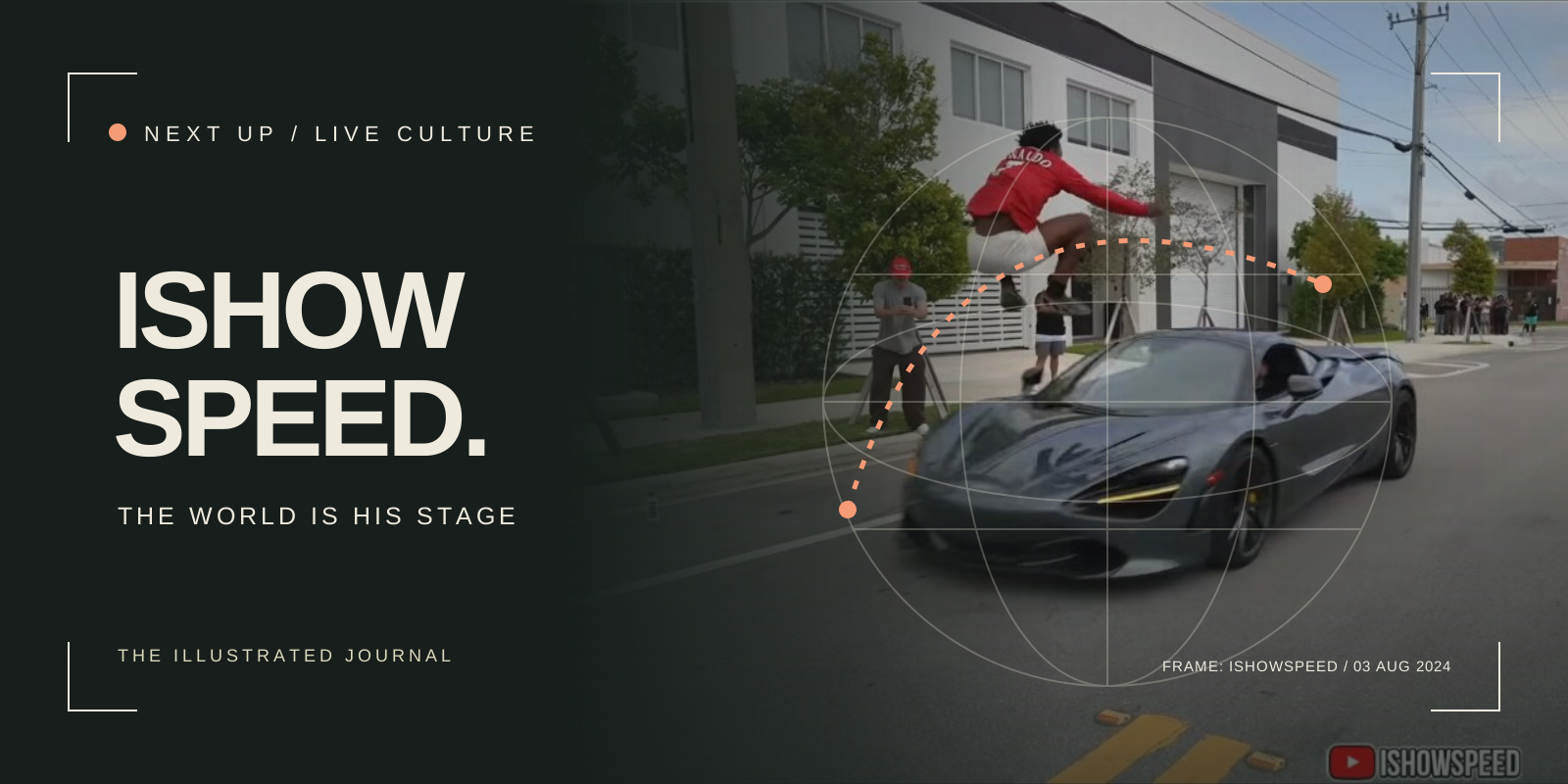
On 3 August 2024, the spectacle became a Lamborghini and a McLaren arriving one after the other. Speed’s original livestream shows him clearing both. A red Ronaldo shirt, an ordinary street, people holding their phones: the setting makes the feat feel even more improbable.
The preparation is part of its force. He asks for his Lamborghini to go first and the McLaren second. He checks who is recording and where the cameras are pointing. There is time to hesitate, change something and feel the weight of the audience waiting. Then the cars arrive, and the jumps are over in seconds.
“Kobe used special effects. Speed did it in real life.”
That is the comparison that makes this extraordinary for me. Kobe’s 2008 Nike car-jump used special effects, the Los Angeles Times reported. Here, the camera keeps running through Speed’s attempt and into the celebration. An image associated with an advert’s illusion has become something a streaming audience can witness unfolding.
The athletic ability deserves its own recognition. Clearing the first car is only half the scene; another is already on its way. Speed has to gather himself for a second jump before there is much time to celebrate the first. The result is an outrageous piece of live entertainment, with all the danger that description implies.
What “I WAS HERE” means
Around the preparation for the attempt, a viewer with the handle @efriseer writes in chat: “I WAS HERE”.
Three words turn watching into a declaration of attendance. The jump has not yet happened. The viewer is already claiming a place in the story of it: if this becomes a moment people talk about later, I was there before anybody knew the ending.
A streamer’s chat is the stream’s live message column. Viewers can respond to the host and to one another while the broadcast continues. At its best, it gives people watching separately a way to share the same occasion. A recurring joke, a familiar username or a well-timed message can make a huge broadcast feel like a place with its own regulars.
But those messages are also a performance. “I WAS HERE” addresses the other viewers as much as the streamer. It asks for a tiny piece of the event’s memory. The recording may preserve the moment, but the chat records the desire to belong to it.
Look at the messages around it. Some viewers encourage Speed; others doubt what they are seeing or urge him to stop. The column contains enthusiasm, concern, jokes and questions at the same time. Its movement can look like one crowd roaring, even when its participants want different things.
That is part of chat’s power. An audience can welcome someone, celebrate a success or make uncertainty harder to sit with. A host who keeps addressing “chat” is performing in a social setting, even when most of the spectators are physically elsewhere. The messages do not prove why Speed made his decision, but they help us understand what it means to make that decision in public.
The relationship runs both ways. Speed gives the viewers something to gather around; their presence helps make the broadcast an occasion. A clip can show you the leap. The live stream also gives you the waiting, the disagreement and the feeling of being there together.
The audience leaves the screen
His international streams make that achievement visible. Reporting from his Africa tour in January 2026, the Associated Press described a journey across twenty countries, with long YouTube broadcasts, local food, dancing, sporting challenges and crowds gathering around him. The people who had watched through a screen could now stand within reach of the camera.
That changes the programme. A fan can become part of the encounter they came to watch. The crowd supplies its own reactions; the entertainer has to respond to a place and to people who have expectations of him. The performance no longer belongs entirely to one person.
For someone watching from another country, the appeal can extend beyond Speed himself. An unfamiliar street, a meal or a conversation arrives inside entertainment they already chose. Curiosity has a familiar guide. There is an opportunity in that, provided the place gets to be more than scenery for the visitor.
There is a limit, too. A camera follows a route selected by somebody. A live broadcast still has a team, a frame and things happening outside it. Neither a welcoming crowd nor a difficult encounter can represent an entire country. The useful invitation is to learn more about the people on screen, rather than assume one stream has explained them.
The scale of his appeal has also become attractive to established entertainment organisations. In July, YouTube announced Speed as the lead creator for its first FIFA Creator Cup in New York, with a global broadcast on FIFA’s channel and a simulcast on his own. His audience was part of the event’s proposition from the beginning.
A different use for the camera
The Eyes of Ghana offers a more revealing next step. The film’s official credits name Speed as a producer and Barack and Michelle Obama as executive producers. Ben Proudfoot directs. It follows Chris Hesse, the cinematographer who filmed Ghana’s first president, Kwame Nkrumah, and his effort to preserve an extraordinary record of African independence.
The film’s website advertises theatrical screenings for 28 October 2026. At the time of writing, that date is still ahead. Its effect on Speed’s audience remains to be seen, and a producer credit alone does not tell us the full extent of his creative involvement.
But the possibility is compelling. Someone whose appeal depends on what happens next can help draw attention to images whose value depends on their survival. Hesse’s work gives the camera another obligation: making sure a future audience has something to look back at.
That is a meaningful development for a creator associated with the instant reaction. Can the attention follow when the central story belongs to someone else? Can the enthusiasm surrounding Speed become interest in the person he is asking people to notice?
What greatness would have to mean
Calling him the next GOAT makes an entertaining argument, but it leaves the criteria conveniently blank. Biggest crowd? Most recognisable personality? Longest career? Cultural contribution? Those are different achievements, and the last two take time to judge.
The more interesting possibility is that his career can grow without remaining trapped inside its earliest appeal. The teenager responsible for a reckless bedroom spectacle does not have to repeat that spectacle forever. Nor does a prestigious film credit erase the responsibility attached to his platform.
For Infinity Illustrated, this is where the story becomes worth following: what happens when an entertainer’s curiosity develops alongside his reach. Embrace Tomorrow should leave room for that development, while asking what it contributes.
Speed has already shown that people will travel to see him. If he can persuade them to spend time with a story they would otherwise have passed by, he gives that extraordinary attention somewhere else to go.
Infinity Illustrated.
Embrace Tomorrow.