Music That Shapes Us
Wiz Khalifa & Curren$y: How Fly and Rap’s Blog Era That Felt Like Ours
Wiz Khalifa, Curren$y and How Fly capture rap’s blog era: mixtapes, style, cannabis culture and Enzo’s memories of running Ask How Fly.
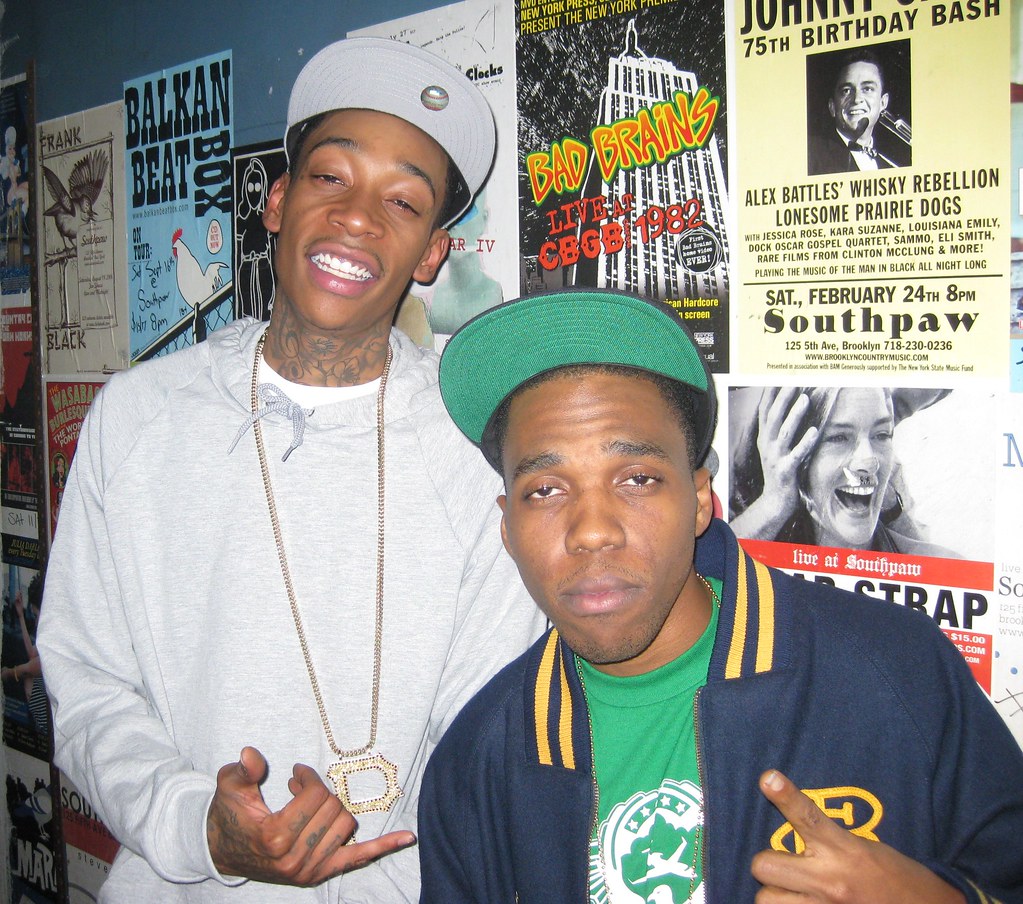
Photograph: Cfro / hiptics · Southpaw, Brooklyn · 20 October 2009.
Before Kush & Orange Juice took off, knowing about Wiz Khalifa and Curren$y could tell me something about a person.
It was a particular kind of cool. Knowing the music suggested that I could smoke around you, relax and trust you to let it be an ordinary part of the afternoon. You understood the attraction without needing to turn it into a performance. The recognition came easily: you were listening to this too.
Camo shorts. Chuck Taylors. A mixtape somebody had sent you. The feeling that a rapper's way of spending the day might fit quite comfortably into your own.
That is why the blog era still feels personal to me. Wiz and Curren$y gave it a sound and a recognisable way of carrying yourself. The websites around them gave people places to find it, talk about it and pass it on. Discovering the music could become the beginning of a friendship, or another thing an existing friendship had to itself.
The route to a new song
For this piece, the blog era means the overlapping rap-web culture of the late 2000s and early 2010s, following the buildup from 2007 through 2012. Its boundaries are debatable. The useful thing to identify is how discovery worked.
You learned which websites suited your ears. A post might lead to a song, an embedded video, a mixtape page or another blog. The writer's taste became familiar. Eventually, a recommendation from that person carried enough weight for you to try an artist whose name meant nothing to you yet.
Nah Right, 2DopeBoyz, The Smoking Section, OnSMASH, Rap Radar and DJBooth occupied different parts of that network. DatPiff and LiveMixtapes provided another part of the experience: somewhere to get and play the tapes. Blogs, file hosts, artist pages, MySpace, YouTube and Twitter worked alongside one another. Calling the whole thing “the blogs” is convenient shorthand for several kinds of infrastructure, and a lot of people's work.
WorldStarHipHop was part of those daily rounds too—hip-hop’s own YouTube in the way people used it. Music videos, interviews and viral clips sat together in a feed you checked to see what had landed since yesterday. In a 2010 Parlé interview, founder Lee “Q” O’Denat described how he had shifted the site fully towards video in 2007, with a mixture designed to keep people coming back.
In a November 2009 Unkut interview, Nah Right founder eskay explained his approach: put up the music, let people listen and allow them to form their own opinions. A short post could be useful precisely because it got you to the song quickly. The site also had a continuing conversation among regular readers.
Human taste did not mean universal access. Somebody still decided who appeared on the front page. In a later interview about their Blog Era podcast, ItsTheReal described the importance of a Nah Right placement and the traffic a link could bring. The era opened routes into rap while giving particular curators considerable power over those routes.
Still, following a small collection of sites created a satisfying familiarity. You knew where to look tomorrow. You could remember who had put you onto something.
Rap was arriving from several directions
The artists associated with that period had different histories and ambitions. Curren$y had already been through No Limit and Young Money before finding a sustainable independent audience. Wiz had experienced a frustrating Warner Bros. deal. These were working rappers finding a better route to their listeners.
Wale made the Seinfeld references of The Mixtape About Nothing and More About Nothing part of a distinctive identity. Mac Miller's K.I.D.S. made a young Pittsburgh audience feel visible well beyond Pittsburgh. Nipsey Hussle built his Marathon identity around patient work and independence; explaining All Money In to The FADER, he described reinvesting in equipment, studios and infrastructure.
Big K.R.I.T.'s free projects carried Mississippi into the same online conversation. Around them were J. Cole, Kid Cudi, Big Sean, The Cool Kids, Pac Div, Dom Kennedy and Smoke DZA, among many others. Different local scenes, existing mixtape traditions and new online audiences overlapped. No single blog, city or musical formula explains them all.
The exciting possibility was that you could recognise somebody's individuality before a major commercial breakthrough. Following them did not require waiting for the rest of the industry to agree.
That helps explain why the tapes could become so attached to a listener's own life. They were arriving while people were deciding what to wear, who to spend time with and what kind of person they wanted to be. An artist's development and a fan's development could happen in parallel.
The climb to How Fly
By the time How Fly arrived, both rappers had given listeners years of music to live with. Wiz's run already included the album Show and Prove (2006), the mixtapes Grow Season and Prince of the City 2 (2007), Star Power (2008), and Flight School in April 2009. Each new project gave the people following him another reason to keep paying attention.
Curren$y's own run included Independence Day, Higher than 30,000 Feet and Fast Times at Ridgemont Fly, all from 2008. His debut album, This Ain't No Mixtape, arrived digitally in April 2009. The flight imagery, movie references and particular sense of taste were established long before the collaboration. The groundwork was already there.
For me, How Fly sits close to the pinnacle of that shared underground moment. The excitement was having two rappers you already followed together for an entire tape. Their audiences had histories with them, favourite projects and reasons to expect something special. How Fly gathered that accumulated enthusiasm into one release.
LiveMixtapes dates How Fly to 9 August 2009. Even its track list offers a small itinerary: “Car Service,” “The Check Point,” “The Planes,” “Layover,” “Surface to Air,” “Over the Building.” Getting around becomes a whole imaginative setting. The promise of movement gives an ordinary day somewhere to go.
The promotion has its own appeal now. Wiz's official YouTube channel still carries the two How Fly commercials uploaded in June 2009. The first advertised an upcoming July release; the tape's eventual August date is a useful reminder that anticipation was part of the experience. People were following a project as it took shape, not simply selecting a finished title from a catalogue.
A review on The Musik Lounge, published on 31 August 2009, calls Wiz and Curren$y “Two of Hip Hop’s best kept secrets.” More revealingly, the writer hears confidence without the aloofness they associate with fashionable exclusivity. That matters because the assessment belongs to the moment itself. The friendliness is something a contemporary listener noticed, rather than a feeling we have invented entirely in retrospect.
The next expansion in Wiz's audience came with Kush & Orange Juice on 14 April 2010. Reporting two days later, XXL described its rapid rise through Twitter's trending topics and Google search interest. In an October interview with Exclaim!, Wiz recalled fans posting their own pictures of cannabis and orange juice before the release. They had begun acting out the idea before the music arrived.
Those details explain more than a download total could. A title had given people something to participate in. They could show their anticipation, recognise one another and help circulate the release.
Wiz's account of the distinction is telling: he described mixtape music as “more every day.” The intimacy was built into the format. The songs could accompany your routine while the artist was letting you see pieces of his.
Wearing the afternoon
The clothes made that familiarity visible. The shorthand I remember is camo shorts and Chuck Taylors, with the broader Taylor Gang world adding caps, jerseys, tanks and an easy disregard for dressing as if every day were a red carpet.
Contemporary coverage supports that picture. DJBooth's July 2011 Summerstage report describes long shorts, high socks, Chuck Taylors, throwback jerseys and backwards caps. Speaking to Forbes that August, Wiz connected the Taylor name to wearing Chucks, then explained how it had grown into an idea about individuality.
You could participate at the scale of a pair of shoes. That accessibility helped turn admiration into identification. A listener might never own the cars or take the flights, but could understand the pleasure of choosing an outfit, putting on the right tape and feeling comfortable in their own company.
Snoop is the comparison I keep reaching for: the ease, the humour, the way smoking could become an entire social identity. Wiz and Curren$y made that identity feel particularly close to the generation finding them online. They also belonged to a longer lineage that includes Cypress Hill, Method Man and Redman, and Devin the Dude. Those artists were already part of the conversation; The Musik Lounge's 2009 review explicitly places the duo among those predecessors.
The distinctive achievement was how thoroughly Wiz and Curren$y joined the music to an everyday lifestyle. Weed, clothes, cars, jokes, friendship and ambition could occupy the same afternoon. Their cool allowed enthusiasm. You could care about a sneaker or a favourite rapper without spending the whole time trying to appear above it.
The old tabs are still there
The surviving blogs make that world tangible again. A Wayback capture of T.G.O.D. x JETS from 28 July 2011 presents Wiz, Curren$y and Mac Miller updates alongside clothing drops, interviews, photographs and a Taylor Gang skimboarding video. Its blogroll links to Rap Radar, 2DopeBoyz, Ashley Outrageous and Ask How Fly.
Ask How Fly's 8 August 2011 capture links back to T.G.O.D. x JETS. Music, fashion, culture and sports sit in the navigation. A Pheo post shares the page with artist interviews and a Wiz speed-painting video. That assortment explains the attraction better than a perfectly organised retrospective could: the music was part of a larger collection of interests.
I had a small part in this. I bought Ask How Fly from Ridgemont Flyy and ran it for a while. The best part was being at the forefront, sharing my friends' music with an audience who might otherwise have found it later: Speak, Cashius Green, Pheo, Dre Biggity, Reem and the UTB Life$tyle circle.
Being on the frontline of hip-hop served me a million times better than the flightline of some wars.
I got to tour with UTB on the He Has Risen tour. I remember riding along in the back of a van, then sleeping head to toe: two to a bed, two beds, two on the floor. What a time to be alive.
That is the personal thread I want to keep hold of here. The discovery mattered because there was somebody to share it with.
Before the storefronts
The relaxed image had a harder legal setting. How Fly and Kush & Orange Juice arrived before any US state had legalised adult recreational use. Colorado and Washington approved their landmark measures in November 2012; Colorado's adult-use retail sales began on 1 January 2014. Medical systems already existed in some states, so this was an uneven landscape rather than one identical national experience.
The risks were uneven too. In its 2013 analysis of 2001–2010 arrest data, the ACLU reported that Black people were about 3.7 times as likely as white people to be arrested for marijuana possession despite comparable usage rates. Remembering the ease of the music should leave room for the people who could not move through that world so easily.
The subsequent commercial change is substantial. Colorado's Department of Revenue records combined medical and retail marijuana sales of roughly $684 million in 2014 and $2.23 billion in 2021. The same series falls to about $1.32 billion in 2025. Those are sales in one state, not a US market total, and the later decline complicates any story of effortless, permanent growth.
The music and the emerging business were developing alongside one another. Wiz and Curren$y helped give cannabis culture a visible, appealing identity for their listeners. Turning that recognition into a regulated business also required growers, reform campaigns, licences, investment and a product people wanted. Cultural influence is an important part of that history; it cannot account for the whole change by itself.
Berner, Cookies and the value of recognition
Berner connects those worlds unusually clearly. Taylor Gang's own biography dates his signing to March 2012. A decade later, he and Wiz were launching Khalifa Kush in California through Cookies. In a January 2022 Forbes interview, Berner describes a friendship formed around cannabis that developed into a commercial relationship. The product and the partnership grew out of something they had already been doing together.
Cookies also has a history rooted in cultivation. Reporting on the company in August 2022, Forbes describes Berner's relationship with Bay Area grower Jai Chang and the Girl Scout Cookies strain. Wiz was among the friends to whom Berner introduced the cannabis. Music could give a name enormous reach, but there had to be something behind the name for that interest to endure.
Berner knew how to capitalise on that momentum. Through Cookies, he helped turn a lifestyle people recognised into a brand they were willing to pay for—and it brought in serious money. In its 2022 report, Forbes estimated about $400 million in annual sales across the Cookies network.
My argument is that Wiz and Curren$y helped cultivate the audience and social meaning that made this kind of brand more legible. Wiz's relationship with Berner is a documented example of how that influence became a commercial partnership. Curren$y's place in the wider music-and-cannabis network is clear, including his own collaborations with Berner. Saying Cookies could never have existed without either rapper would go further than the evidence allows, and overlook Jai, other cultivators and the work required to build the business.
What we can see is a powerful exchange: music brought attention to cannabis expertise, while products, clothing and places to gather gave a recognisable musical lifestyle another form.
What is worth carrying forward
Reddit anniversary discussions preserve the smaller memories beneath the familiar “classic mixtape” verdicts. In the How Fly thread, listeners remember journeys to work, first cars and particular songs taking them back to 2009–2010. A Kush & Orange Juice listener remembers a T.G.O.D. lock screen on an iPod touch. Other commenters love the music without having smoked at all. These are individual recollections, not a representative survey, but their specificity helps explain the attachment.
Even returning to the music is complicated. On Trapital, Rostrum founder Benjy Grinberg described the work of clearing old mixtape samples for streaming, and his effort to preserve what fans remembered. A version available today may not contain every element of the original download. Keeping these records accessible involves practical work as well as affection.
There is a particularly direct Infinity Illustrated connection in “The Checkpoint.” The June 2009 upload on Wiz's official channel sets the track against Samurai Champloo animation. Rap and anime were already meeting in the material we were passing around. Coming back to that video now makes our own Champloo work feel connected to a much older habit of enjoying things together.
The part I want to carry into Infinity Illustrated is the care behind a recommendation. Choose something because it matters to you. Give it enough context for somebody else to find their way in. Remember the friend whose music deserves a new listener.
Wiz and Curren$y made their world recognisable enough for people to see a little of themselves in it. The blogs helped us find one another around that recognition. I still want to be the friend who sends you the link.
Infinity Illustrated.
Embrace Tomorrow.