LIVE CULTURE / VIDEO ESSAY
IShowSpeed: The World Is His Stage
From the car jump to The Eyes of Ghana, Enzo examines IShowSpeed’s relationship with a live audience—and what that attention can make possible.
Watch on YouTube ↗Opens on YouTube.
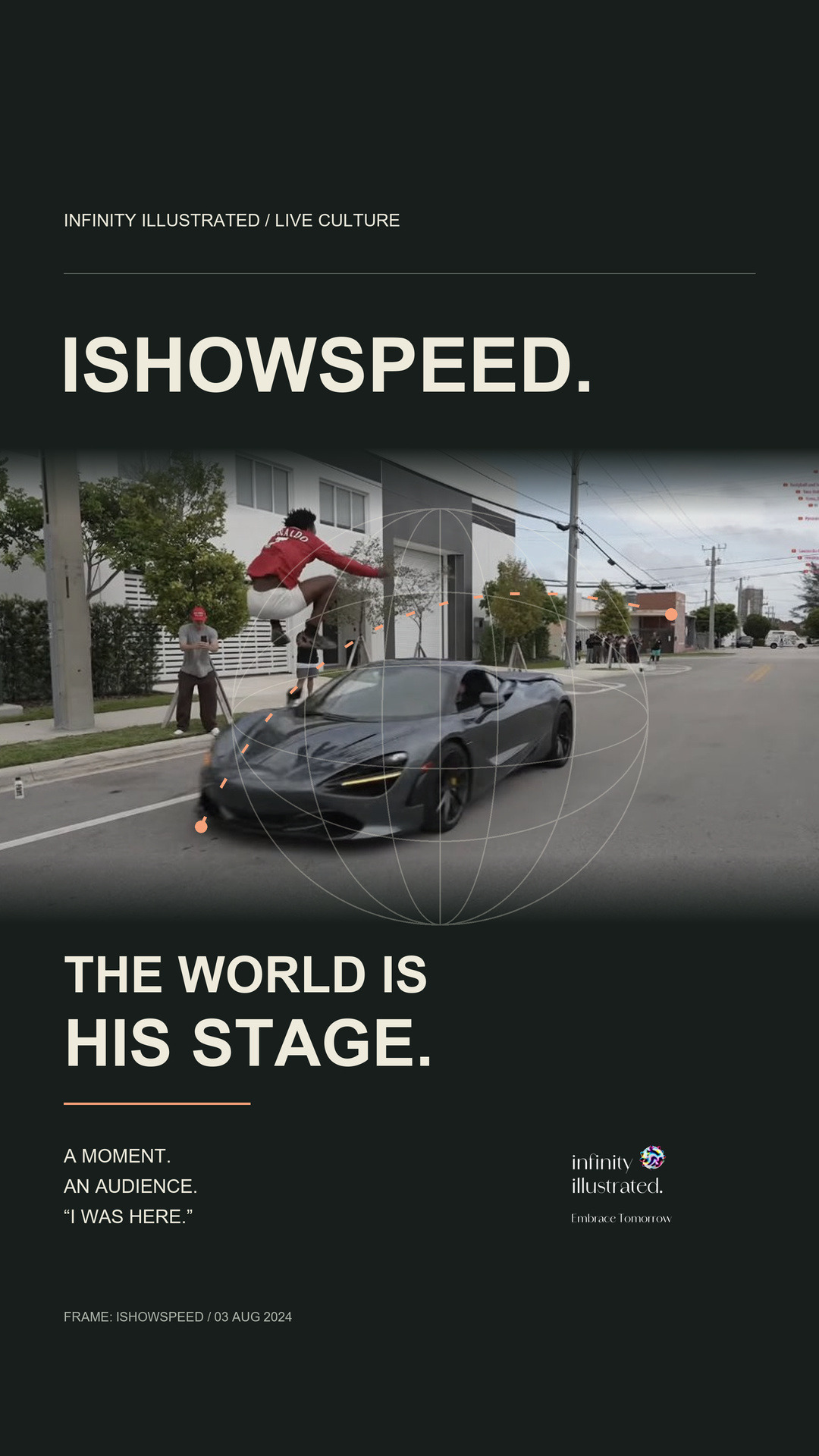
An audience can watch an event afterwards. A live audience has to wait for the outcome. This essay looks at what IShowSpeed does with that difference: the preparation, the uncertainty, the chat and the people who step into his international streams.
The wait is part of the event
The car-jump sequence includes decisions and preparation before the attempt. Those moments give the audience time to anticipate the result. Cutting straight to the leap would remove part of the relationship the essay is trying to understand.
Recognition of the athletic feat sits alongside a question about the risk. The film treats the incident as something to examine, rather than a challenge for somebody else to repeat.
What “I was here” asks for
The chat messages are small attempts to remain attached to a much larger event. A viewer can do more than see the outcome: they can leave a sign that they shared the uncertainty before it happened.
That sense of company has consequences. Chat can encourage, joke, object and urge caution. Addressing everyone as “chat” brings a vast group close enough to answer, even though the people inside it want different things.
Where does the attention go next?
The Eyes of Ghana gives the essay another camera operator to consider: Chris Hesse, whose work preserves images for future audiences. The official film credits name IShowSpeed as a producer, Barack and Michelle Obama as executive producers, and Ben Proudfoot as director.
The question is what an established audience might be invited to notice beyond its familiar performer. This is where the film meets Infinity Illustrated’s Embrace Tomorrow idea: leave room for somebody to develop, while continuing to examine what they do with that room.
Read the narration
Narration from the October 2026 feature, preserved in its original reporting context. Paragraph breaks and quotation punctuation are adjusted for reading. Original footage dialogue and music are not transcribed.
There is a reason people keep watching IShowSpeed.
The noise is obvious. What interests me is the relationship behind it: a performer, a live audience, and the feeling that something might happen.
That relationship is worth a closer look.
In July 2022, a Pikachu-shaped firework went off in his bedroom. Panic, smoke, his mother's alarm, then firefighters.
It was reckless. It also became exactly the kind of clip that travels faster than the explanation around it.
Speed became recognisable through these outsized reactions. A face, a movement, a situation suddenly getting away from him.
You can understand the performance without catching every word.
But there is another skill underneath the volume: making people want to see what happens next.
The preparation for the car jump tells us something about how this works.
He checks the cameras and asks people to record. The cars are ready. The audience is waiting.
The delay becomes part of the event. We have time to imagine everything that could go wrong.
Then it happens.
“Kobe used special effects. Speed did it in real life.”
Kobe's 2008 Nike advert used effects. Speed's broadcast carries on through the attempt and into the celebration.
The athletic ability is remarkable. So is the danger. Applause does not make the decision safe.
During the preparation, the same three words keep appearing in chat.
I was here.
Different people, making the same small declaration. Before the outcome, they are already claiming a place in its memory.
That is something a highlight cannot quite give you. You can watch the result later. Live, you share the uncertainty.
Chat gives people in separate rooms a way to attend the same occasion. They joke, encourage, doubt, and tell him to stop.
Read those messages individually and the crowd becomes less simple. Different people want different things.
The host keeps addressing them as one: chat.
That little word makes a huge audience feel close enough to answer. It can create belonging. It can also make backing down feel public.
We cannot know what decided the jump. We can see that he is making the decision with people watching.
On his international streams, those people step into the picture.
Reporting on his twenty-country Africa tour in January 2026, the Associated Press described food, dancing, sporting challenges, and crowds gathering around him.
A viewer can become a participant. Someone offers a meal, teaches a move, or starts a conversation. Speed has to respond.
For the audience at home, an unfamiliar place arrives through somebody they already know.
That can open a door. The responsibility is to notice who lives beyond it. One visit cannot explain a country, and the people on screen deserve more than a supporting role in somebody else's adventure.
In his announcement for The Eyes of Ghana, Speed says visiting Ghana felt like home. He says he reached out to ask how he could help.
He is credited as a producer. Barack and Michelle Obama are executive producers. Ben Proudfoot directs.
The documentary follows Chris Hesse, the cinematographer who recorded Ghana's first president, Kwame Nkrumah, and his work to preserve films of African independence.
Here is another man with a camera, working on a different timescale.
Speed's audience waits to see what happens next. Hesse's archive helps future audiences see what happened before.
The film has announced screenings for October twenty-eighth. Its wider impact remains ahead of us.
But the invitation already matters: spend some of your attention on this man's story.
This is the part of his story worth following.
Recognising his ability leaves room to question his decisions. His audience is established. What remains open is what he chooses to do with its attention.
For Infinity Illustrated, Embrace Tomorrow means leaving people room to develop, while still asking what they do with that room.
He can get an audience to follow him.
Now, can he get them to look closely at somebody else?
Infinity Illustrated.
Embrace Tomorrow.
Continue exploring
Infinity Illustrated.
Embrace Tomorrow.